"When teachers have a strong sense of professional community their morale is better and teacher commitment is higher. Professional community helps support teaching practices, and helps teachers address the uncertainty that accompanies nonroutine teaching of the sort encouraged by many school reform initiatives."
Adam Gamoran


It is often said that the most important asset of any enterprise is the talent and enthusiasm of its workforce. Education is no exception to this premise.
Being teachers such a vital element in the educational process, when designing policies aimed at getting better academic results, what policymakers must not forget is that teachers are no different from employees in the private sector. They want to succeed in their jobs and they demand the tools, the respect, and the sense of empowerment necessary to reach this goal.
As University of Washington scholar Dan Goldhaber stands, "It appears that the most important thing a school can do, is to provide its students with good teachers".
But teachers are known to improve when they analyze, evaluate, and experiment with colleagues in purposeful learning communities (Fullan, 2001). Fullan also suggests that the school level change strategy is developing professional learning community within schools and emphasize the importance of strong teacher community. Therefore, teachers need to be enabled and encouraged to establish a community of learners among themselves (Lave & Wegner, 1991). Maclaughlin and Talbert (2001) also indicated that a collaborative community of practice in which teachers share instructional resources and reflections in practice appear essential to their persistence and success in innovating classroom practices (p.22).
Building up organizations that are able to learn – according to Kofman and Senge- requires basic changes in the ways people think and interact. “The heart of the learning organizations are communities of commitment. Without communities of people genuinely committed to the organizations’ goals, there is no real change”.

ARTIGAS, URUGUAY

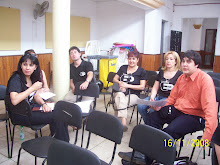
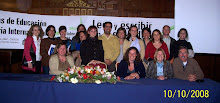
"Shapers" 2007: the net is officially born

"Shapers" 2007: the net is officially born

NEW MESSAGE. CHECK IT OUT!


jueves, 11 de marzo de 2010

P.A.D. Andrea Sorondo's motivating letter to her colleague teachers.


letter_2010


Andrea Sorondo's motivating words to her colleagues, on the occasion of her first sala in Soriano. She was kind enough to let us share them with you. We hope you find them as inspirational as we did.
Thanks, Andrea!

Some words on CRITICAL THINKING - By P.A.D. Oscar Vairo (Florida)


Improving_students


We would like to thank Oscar Vairo for his kind -and generous- contribution to our blog.
This article is based on a workshop that was held in February in Florida. (Thanks again, Oscar!)

martes, 9 de marzo de 2010
IMPORTANT

Thursday,  11th march, 10:00 A.M., "elección de horas" at high school number 1 (Artigas).

Positions to be offered:

*** 7º, 8º, 9º, in Guayuvira, Montes Quintela and Colonia Palma
*** and one group (2nd grade- "interinato") at liceo number 4 (Mondays, Tuesdays, Wednesdays and Saturdays from 5:00 P.M. to 5:45 P.M.)

INSPECCION'S NEWSLETTER


March_2010

domingo, 7 de marzo de 2010

DIAGNOSTIC TESTS: ARTIGAS AND BELLA UNION WORKING AS ONE

"The most important single factor influencing learning, is what the learner already knows. Ascertain this, and teach accordingly." DAVID AUSSUBEL

Diagnostic tests on a Saturday morning. Virtual teamwork (networking, actually) with Bella Union.

sábado, 6 de marzo de 2010

March 4: CEIBAL MEETING AT LICEO DEPARTAMENTAL

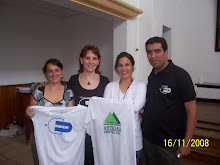
From left to right: teachers Patricia Dos Santos, Lorena Bustamante and Nidia Balbuena.
Teachers Beatriz Sendic, Delia Leites de Moraes, Genny de Souza (and baby), María Noel Cabezas, Teresita Correa and Diego Correa.
Teachers B. Sendic, María Noel Cabezas, Teresita Correa, Andrea Fernández, Natalia Sena and Loana de Cuadro.
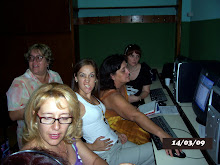
Teachers Loana de Cuadro, Anarella Gómez, Mary Rodríguez, Rosario Gómez and Sandra Conti.

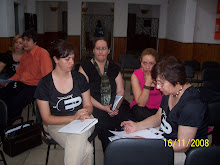
First study-group meeting at Liceo 4